URL Redirect Checker
Enter any URL and trace its complete redirect chain: every hop, every status code (301, 302, 307, 308), and the final destination. Spot the redirect chains and loops that slow pages down and leak SEO equity.
Note: this tool uses a tiny serverless function to follow redirects (browsers can't inspect redirect chains directly). If you're seeing this after deploying, make sure the functions/ folder was included in your Cloudflare Pages deployment — it's in the site package and deploys automatically.
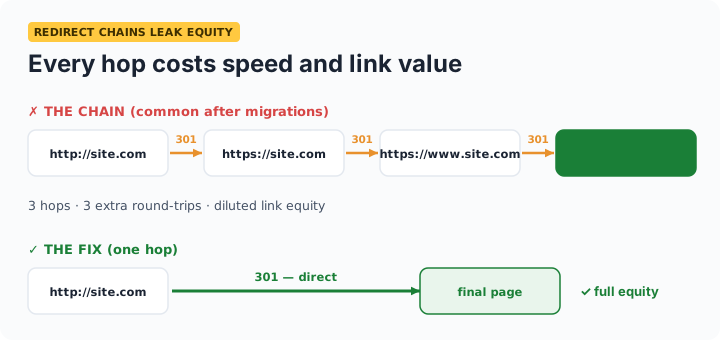
Why chains matter: each redirect hop adds latency and dilutes link equity. Google follows up to 10 hops, but best practice is a single hop — if A redirects to B and B redirects to C, point A directly at C.
301 vs 302: which redirect should you use?
| Code | Meaning | Use when | SEO effect |
|---|---|---|---|
| 301 | Moved permanently | Page moved for good, domain migration, https upgrade | Passes link equity to the new URL; old URL drops from index |
| 302 | Found (temporary) | A/B tests, temporary campaigns, maintenance | Old URL stays indexed; equity stays with it |
| 307/308 | Strict temporary / permanent | When the request method must be preserved | Same as 302/301 respectively |
The most common SEO mistake is using 302 for a permanent move — search engines keep the old URL indexed and the new page struggles to rank. The second most common is chains left over from multiple migrations: http → https → www → new-path. This checker exposes exactly that.
Frequently asked questions
What is a redirect chain and why is it bad?
A chain is a redirect pointing to another redirect (A to B to C). Each hop adds latency for users and dilutes the link equity passed to the final page. Google follows up to 10 hops but recommends redirecting directly to the final URL in one step.
What is the difference between a 301 and 302 redirect?
301 means permanently moved — search engines transfer the old URL's ranking signals to the new one. 302 means temporary — the old URL stays indexed. Using 302 for a permanent move is one of the most common SEO mistakes.
How do I fix a redirect loop?
A loop (A to B to A) usually comes from conflicting rules — for example, a CMS forcing https while a CDN forces http, or two plugins both redirecting. Trace the chain here to see the exact loop, then remove or align the conflicting rule.
Why does this tool use a serverless function?
Browsers can't inspect another site's redirect chain directly — cross-origin security hides the intermediate hops. The included Cloudflare Pages Function (free tier) follows the redirects server-side and reports each hop back. It deploys automatically with the site.