Unix Timestamp Converter
Paste an epoch timestamp and get the human date in UTC, your local timezone, and IST — or pick a date and get its epoch in seconds and milliseconds. Seconds vs milliseconds is auto-detected from digit count.
Current epoch: … (seconds · updates live)
What's a Unix timestamp? The number of seconds elapsed since 00:00:00 UTC on 1 January 1970 (the "epoch"). It's timezone-free, compact, and sortable — which is why databases, APIs, and logs use it. JavaScript uses milliseconds, which is why some timestamps have 13 digits instead of 10.
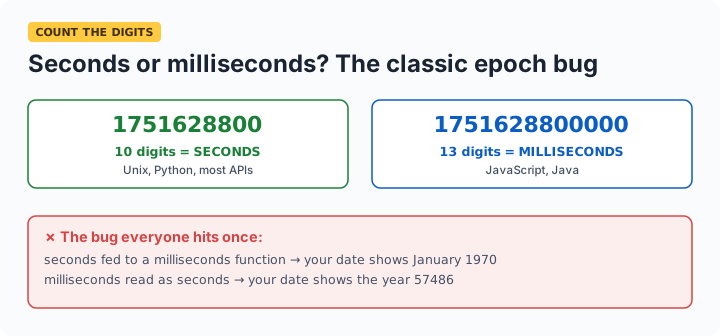
Seconds or milliseconds? Count the digits
| Digits | Unit | Comes from |
|---|---|---|
| 10 (e.g. 1751628800) | Seconds | Unix, Python time.time(), most APIs and databases |
| 13 (e.g. 1751628800000) | Milliseconds | JavaScript Date.now(), Java System.currentTimeMillis() |
| 16 | Microseconds | Some databases and logging systems |
The classic bug: passing a seconds timestamp where milliseconds are expected shows a date in January 1970; the reverse shows a date fifty thousand years away. If your date looks absurd, it's almost always a units mismatch — this converter auto-detects from digit count so you can see which one you actually have.
Frequently asked questions
Why does my timestamp show a date in 1970 or the year 54000?
Units mismatch. A seconds value fed into a milliseconds function lands near January 1970; a milliseconds value read as seconds lands tens of thousands of years in the future. Count the digits: 10 means seconds, 13 means milliseconds.
Are Unix timestamps affected by timezones?
No — that's their superpower. An epoch is a single global instant (seconds since 1970-01-01 UTC). Timezones only enter when you format it for display, which is why this tool shows the same instant in UTC, your local zone, and IST simultaneously.
What happens in 2038?
The year-2038 problem affects systems storing epochs as signed 32-bit integers, which overflow on 19 January 2038. Modern systems use 64-bit integers and are fine for 292 billion years. JavaScript and this tool are unaffected.
Does an epoch include leap seconds?
No — Unix time pretends leap seconds don't exist (each day is exactly 86,400 seconds). For virtually all application purposes this is what you want; only specialized scientific timing cares about the difference.